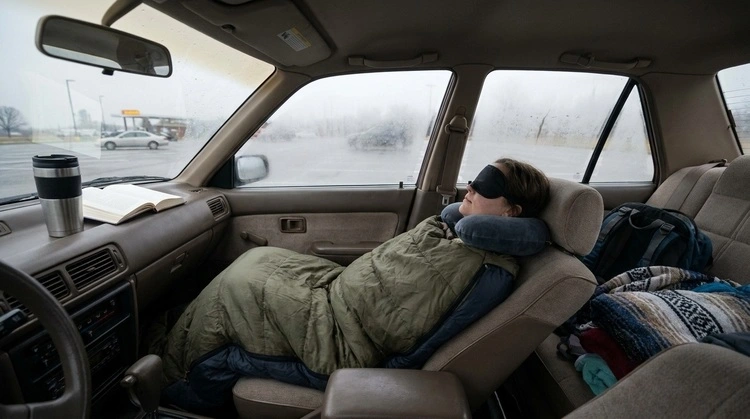
How Long Can You Stay in a Car With Windows Closed?
Imagine this: You’ve been driving for hours, your eyes are heavy, and all you want is a quick 20-minute power nap at a highway rest stop. Or maybe you’re sitting in a parking lot, waiting for a friend while a heavy downpour splashes against your windshield. Naturally, you roll up all the windows to keep out the noise, rain, or chilly draft. But as you settle back, a sudden creeping thought hits you: Is it actually safe to stay inside a completely sealed car? Will I run out of air?
It’s a question millions of drivers silently ask themselves every day. The short answer? You won’t suffocate overnight just from closing your windows, but staying inside a closed vehicle comes with hidden, fast-moving hazards that catch most people completely off guard. From rapid heat accumulation to invisible gas buildup, sitting in a parked car is far more complex than it seems.
Here is everything you need to know about the science, the risks, and the exact safety limits of staying inside a closed automobile.
The Science of Vehicle Air Supply: Can You Really Suffocate?
The fear of waking up gasping for air inside a sealed vehicle is extremely common, but it stems from a basic misunderstanding of how modern automobiles are built.
How Air Circulates in Non-Airtight Automobiles
Cars are designed to keep out rain, snow, and wind, but they are far from pressure-sealed spaces. Modern vehicles are filled with structural gaps, body seams, and tiny passages around door frames and trunk seals. More importantly, every car features a dedicated heating, ventilation, and air conditioning (HVAC system) that connects the interior cabin directly to the outside world through intake and exhaust vents.
Even when your car is turned off and every window is rolled completely up, natural air exchange still occurs. On average, the cabin air in a standard sedan replaces itself roughly one to three times every hour due to outdoor air currents and natural pressure differences. Unless a car is deliberately modified or submerged in water, ambient air is constantly creeping inside.
Oxygen Depletion vs. Carbon Dioxide ($\text{CO}_2$) Buildup
Human breathing mechanics also lower the immediate risk of suffocation. The air surrounding us contains roughly 21% oxygen. When an adult inhales, their lungs extract only about 5% to 6% of that oxygen, exhaling the remainder back out. Because a standard midsize vehicle holds between 3,000 and 4,000 liters of interior air, a single person sitting quietly consumes oxygen at a very manageable rate.
However, oxygen isn’t the primary issue—carbon dioxide ($\text{CO}_2$) is. As you sit in a confined space, every exhalation releases $\text{CO}_2$ back into the cabin. In a completely closed car without active airflow, $\text{CO}_2$ levels steadily rise long before oxygen levels drop to dangerous zones. Within 30 to 60 minutes, high concentrations of carbon dioxide can cause subtle physiological changes, including:
- Persistent drowsiness and lethargy
- Mild headaches or a feeling of “heaviness” in the head
- Reduced mental clarity and slower visual reaction speeds
- A sudden surge of unexplained restlessness or anxiety
High-Occupancy Risks: What Happens with Multiple Passengers?
The mathematical safety margin changes drastically the moment you add more living bodies to the cabin. Research into vehicle interior air quality highlights that adding passengers speeds up air degradation exponentially.
If three or four adults—or even a couple of large dogs—are sleeping in the same closed car, they are collectively inhaling available oxygen and exhaling carbon dioxide at four times the normal rate. In packed vehicles, carbon dioxide levels can reach uncomfortable, brain-fog-inducing thresholds in as little as 15 to 20 minutes. While complete suffocation remains rare, the resulting air quality quickly becomes stale, stuffy, and unsafe for anyone needing to stay alert.
Safe Confinement Limits: How Long Is Too Long?
Because external conditions change dramatically throughout the day, there is no single rule for how long you can safely remain inside a vehicle. Your margin of safety depends entirely on outdoor temperatures, solar radiation, and whether your engine is running.
Environment & Engine Condition Safe Duration Matrix
| Environmental Scenario | Safe Duration Limit | Primary Hazard | Recommended Action |
| Mild Weather ($15^\circ\text{C}$–$20^\circ\text{C}$ / $60^\circ\text{F}$–$70^\circ\text{F}$), Engine Off | 20–30 Minutes | Stale air, rising $\text{CO}_2$ levels | Crack windows slightly for cross-ventilation |
| Hot / Sunny Weather ($24^\circ\text{C}+$ / $75^\circ\text{F}+$), Engine Off | 0–10 Minutes | Heatstroke, severe dehydration | Avoid staying inside; move to shaded areas |
| Freezing Weather, Engine Off | 30–60 Minutes | Hypothermia, rapid body heat loss | Use thermal blankets and insulated layers |
| Any Weather, Engine Idling | Not Recommended | Carbon monoxide poisoning | Turn off the engine before resting or sleeping |
Vulnerable Groups: Special Risks for Children and Pets
While a healthy adult might tolerate brief shifts in air quality or temperature, children and household pets operate on a completely different biological timeline.
A child’s body surface area is significantly larger relative to their total weight compared to an adult, meaning their body heat rises three to five times faster. Furthermore, young children and animals cannot sweat as efficiently to cool their core temperatures down. Leaving a child or pet inside a closed car—even for “just five minutes” to run a quick errand—can turn fatal with shocking speed.
Thermal Dynamics: Why Automobiles Act Like Greenhouses
The biggest threat inside a closed car isn’t running out of air—it’s the extreme shift in temperature. When parked in the sun, vehicle glass acts like a one-way heat trap. Solar radiation passes easily through the windshield and side windows, warming the dashboard, seats, and interior trim. These dark surfaces absorb energy and radiate it back as thermal heat, which gets trapped under the glass.
Even on a mild $24^\circ\text{C}$ ($75^\circ\text{F}$) day, interior temperatures can jump to $38^\circ\text{C}$ ($100^\circ\text{F}$) in just 20 minutes. Cracking a window slightly slows this effect down, but it does not stop it. In extreme summer conditions, sitting in a sealed car can trigger severe dehydration, heat exhaustion, and fatal hyperthermia within minutes.
Winter Confinement: Freezing Temps and Condensation Concerns
Cold weather poses the opposite problem. Vehicles lack heavy household insulation; once you turn off the ignition, cabin heat escapes rapidly through the thin metal panels and glass. Sitting sealed in a car during winter can lead to rapid body heat drop and hypothermia.
Additionally, as you breathe in a cold space, your body exhales moisture that condenses on the cold interior glass. This condensation limits visibility and creates a damp, humid atmosphere that accelerates body cooling. To stay warm safely, rely on thermal sleeping bags and layered clothing rather than keeping the vehicle sealed or the heat running continuously.
Carbon Monoxide (CO): The Silent Poison
When people worry about suffocating in a car, they are usually describing the invisible danger of carbon monoxide ($\text{CO}$) poisoning. Unlike natural air degradation, $\text{CO}$ is a colorless, odorless, and tasteless gas produced by internal combustion engines.
       [ Engine / Exhaust Leak ]
                   │
                   ▼
     ( Emits Toxic Carbon Monoxide )
                   │
                   ▼
   [ Drawn into Air Intake Vents ]
                   │
                   ▼
[ Bloodstream: CO Binds to Hemoglobin ]
                   │
                   ▼
  ( Oxygen Transport Drops to Zero )
When inhaled, carbon monoxide binds to the hemoglobin in your bloodstream roughly 200 times more effectively than oxygen. This starves your brain, heart, and vital organs of oxygen without triggering a conscious gasping response. Initial signs include:
- Sudden dizziness, confusion, or severe nausea
- A dull, throbbing headache
- Weakness, chest pain, and loss of muscle coordination
Exhaust System Failures and Blocked Tailpipes
Sleeping or resting in a car with the engine idling is extremely hazardous. If your vehicle has a small underbody exhaust leak, fumes can leak directly into the cabin.
Environmental blockages create similar risks. If your tailpipe is covered by snowdrifts, mud, or sand, exhaust gases cannot escape into the surrounding air. Instead, they bounce back underneath the vehicle chassis and get sucked straight into your car’s HVAC air intake vents.
Best Practices for Sleeping or Taking a Break in Your Car
If you must take a nap or spend extended time inside your vehicle, follow these simple safety rules:
- Turn the Engine Off: Never fall asleep with the engine running—period. Warm up or cool down the cabin before turning off the key.
- Use the “Half-Inch Rule”: Roll down two opposing windows by about half an inch ($1\text{ cm}$). This creates a reliable cross-breeze that vents out carbon dioxide and moisture without compromising personal security.
- Park Smart: Choose open, well-lit designated rest areas far away from idling semi-trucks or enclosed garages.
- Keep Tailpipes Clear: Double-check that your exhaust pipe is free of snow, dirt, or debris before settling in.
Vehicle Sleeping Laws and Anti-Idling Regulations
Before parking overnight, check local regulations. Many cities enforce strict anti-idling laws to reduce emissions, alongside local ordinances that restrict sleeping in vehicles within residential zones. Stick to marked highway rest stops, truck stops, or approved camping areas to avoid heavy fines or security disruptions.
FAQs
It is generally legal on private property or designated public rest stops, but many cities restrict overnight vehicle sleeping on public streets.
No. Running your engine overnight severely increases your risk of carbon monoxide poisoning from unexpected exhaust leaks or tailpipe blockages.
Open the door immediately, step out into fresh outdoor air, turn off the engine, and seek medical attention if symptoms persist.