When Your Car No Longer Fits Your Life: The Smarter Way to Make a Change
There comes a point when a perfectly good car stops being the right car.
Perhaps you bought a large diesel SUV when you were commuting long distances every day, but now work from home most of the week. Maybe your family has grown, your job has changed or you’ve moved somewhere with better public transport and fewer parking spaces.
Sometimes the change is more subtle. You’re spending more on fuel than you’d like, the car feels unnecessarily large for your everyday journeys, or you’re becoming increasingly curious about whether an electric vehicle would suit you better.
Whatever the reason, it’s easy to find yourself driving a car that no longer matches your circumstances.
The obvious solution might be to sell it and buy something different. But replacing a vehicle is a significant financial decision, and rushing into another long-term commitment can create a whole new set of problems.
For drivers whose needs are changing, the smarter approach may be to rethink what they actually need before deciding what to drive next.
How the Right Car Can Become the Wrong Car
Most people choose a vehicle based on their circumstances at the time.
A long motorway commute might make a comfortable diesel estate particularly appealing. A growing family could justify a seven-seat SUV, while someone living in a city centre might prefer a compact hatchback.
But circumstances rarely stay the same indefinitely.
Changes that can influence vehicle requirements include:
- Starting a new job or switching to hybrid working.
- Moving house or relocating to a different city.
- Having children or becoming an empty nester.
- Taking on a longer or shorter commute.
- Developing new hobbies that require additional luggage space.
- Wanting to reduce fuel and running costs.
- Considering the switch from petrol or diesel to electric.
The problem is that car ownership and finance agreements don’t always adapt easily to these changes.
You might have another two years remaining on a finance agreement, or perhaps you’ve only recently purchased a vehicle that no longer feels practical.
Recognising that your requirements have changed is the first step towards making a better decision.
The Hidden Cost of Driving More Car Than You Need
One of the most common situations involves drivers who continue running larger or more expensive vehicles long after their circumstances have changed.
Consider someone who previously covered 20,000 miles annually and needed a comfortable motorway cruiser.
After changing jobs, their annual mileage drops to 6,000.
Suddenly, the benefits that originally justified the vehicle may be less relevant.
A larger car can mean higher costs for tyres, servicing, insurance and fuel. Depending on the model, it may also involve higher vehicle tax or more expensive replacement parts.
Of course, downsizing isn’t automatically the right answer. A larger vehicle may still provide comfort, safety features and versatility that its owner values.
The important question is whether those benefits still justify the overall cost.
If you’re paying for capabilities you rarely use, it may be worth reconsidering your options.
Downsizing Isn’t Always as Simple as It Sounds
Moving to a smaller car can appear financially sensible, but it’s important not to underestimate your practical requirements.
A compact hatchback might handle everyday commuting perfectly, yet prove frustrating when you need to transport children, pets, pushchairs or holiday luggage.
Similarly, a smaller vehicle might offer excellent fuel economy around town but feel less comfortable during regular motorway journeys.
Before downsizing, think about how often you genuinely need the extra space and capabilities of your current car.
A useful exercise is to record your journeys for several weeks.
Note how many passengers you carry, how frequently you use the boot and whether you regularly travel long distances.
This can reveal whether your current vehicle is unnecessarily large or whether the additional practicality is genuinely worthwhile.
The EV Question Makes Changing Cars More Complicated
For many UK motorists, changing cars now involves a decision that wasn’t previously necessary: should the replacement be electric?
Electric vehicles have become increasingly capable, with more manufacturers offering electric hatchbacks, estates, saloons and SUVs.
However, switching powertrains changes more than the way a car accelerates.
Drivers need to consider charging arrangements, real-world range, journey planning and the cost of electricity compared with petrol or diesel.
An EV may be particularly convenient for someone with off-street parking who can charge overnight.
For a driver living in a flat without reliable access to home or workplace charging, the experience could be very different.
This makes it important to evaluate the entire ownership experience rather than focusing solely on official range figures or advertised running costs.
Why a Test Drive Doesn’t Tell the Whole Story
A 30-minute dealership test drive can tell you whether you like an electric car’s performance, handling and interior.
It cannot fully demonstrate how the vehicle will fit into your everyday life.
Questions such as how frequently you’ll need to charge, whether public charging is convenient and how the car performs during winter are better answered through extended use.
This is one reason a temporary vehicle arrangement can be valuable when you’re considering an unfamiliar type of car.
Don’t Rush Into Another Long-Term Commitment
When a car stops meeting your needs, the temptation is often to replace it immediately.
But making a quick decision can be expensive.
Buying a vehicle involves more than its advertised price. There may be finance charges, insurance costs, depreciation and dealer margins to consider.
If you subsequently discover that your replacement is unsuitable, changing again could mean absorbing another round of costs.
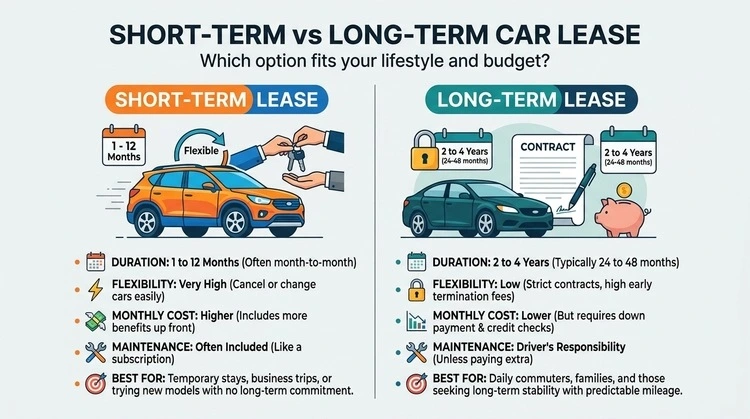
Long-term leasing can present similar challenges. Agreements commonly last several years, and ending one early can involve significant charges.
This doesn’t mean buying or long-term leasing is a bad choice.
For drivers with predictable requirements, both can make excellent financial sense.
The difficulty arises when you’re unsure what your circumstances will look like in six or twelve months.
In that situation, committing to another vehicle for several years may be premature.
Expert Insight: Match the Commitment to Your Circumstances
Adrian Haytor, Founder of Flexxilease, a car leasing specialist in the UK, explains why drivers should reassess their needs before changing vehicles.
“People often choose their next car based on what they’ve always driven rather than what they genuinely need today.
“Someone who previously had a long commute might still be driving a large diesel, even though their mileage has fallen dramatically. Another driver might be considering an electric vehicle but doesn’t yet know whether charging will fit comfortably into their routine.
“The key is to avoid replacing one unsuitable vehicle with another. If your circumstances are changing, giving yourself time to understand your requirements can be far more valuable than rushing into a three or four-year commitment.”
How Short-Term Leasing Can Help During a Transition
Short-term car leasing provides an alternative for drivers who need access to a vehicle without committing to a conventional multi-year agreement.
Depending on the provider and vehicle, agreements may run for periods ranging from a few months to 12 months.
This can be useful when you’re between cars, changing jobs, waiting for a new vehicle or simply reassessing your transport requirements.
For example, someone considering downsizing from a large SUV could use a smaller vehicle temporarily to discover whether it provides enough space.
A driver interested in electric motoring could spend several months experiencing an EV before deciding whether to purchase or lease one for a longer period.
The advantage is flexibility rather than necessarily achieving the lowest possible monthly payment.
Short-term leasing may cost more per month than an equivalent longer agreement, so it’s important to compare the total costs and contract conditions carefully.
Could Buying a Cheap Temporary Car Be a False Economy?
Another option is to buy an inexpensive used car while deciding what to do next.
For some motorists, this works well.
However, the purchase price is only one part of the equation.
Even a relatively inexpensive vehicle can require servicing, tyres, repairs, insurance and an MOT.
There’s also the potential inconvenience of selling it again once you’ve chosen your long-term replacement.
A car purchased for £4,000 and sold several months later for £3,500 has already cost £500 in depreciation before accounting for other expenses.
And if an unexpected repair occurs during that period, the overall cost could rise considerably.
This doesn’t make temporary ownership a poor choice in every situation. It simply highlights why drivers should calculate the full cost rather than assuming that buying an inexpensive vehicle is automatically cheaper.
Work Out What You Actually Spend on Driving
Before changing cars, it’s worth understanding the total cost of your current vehicle.
Many motorists focus primarily on monthly finance payments or fuel bills, but these figures don’t tell the whole story.
Consider:
- Monthly finance or lease payments.
- Insurance premiums.
- Fuel or electricity.
- Vehicle tax.
- Servicing and maintenance.
- Tyres and consumables.
- Parking and emissions charges.
- Depreciation, where applicable.
Once these expenses are considered together, the difference between vehicle types can become clearer.
For example, a more efficient vehicle may reduce energy costs but have a higher monthly finance payment.
Conversely, keeping an older car could avoid taking on a new agreement, even if fuel and maintenance costs are somewhat higher.
The right choice depends on the overall financial picture.
Think About Where You’ll Be Driving Next Year
Your future driving environment is just as important as your current routine.
If you’re planning to move into a city, parking availability and emissions regulations may become more significant.
London’s Ultra Low Emission Zone and Clean Air Zones in other parts of the UK can influence the suitability of certain vehicles.
If you’re considering an older petrol or diesel car, check whether it meets the emissions requirements for the areas you regularly visit.
Likewise, someone relocating from a city to a rural area may find that longer journeys, limited public transport and different road conditions change their priorities.
Planning around likely circumstances can help avoid another unnecessary vehicle change.
Use a Temporary Car as a Real-World Experiment
If you decide to use a temporary vehicle, treat the experience as an opportunity to learn.
Rather than simply driving it until your next car arrives, pay attention to what works and what doesn’t.
You might discover that a smaller vehicle is perfectly adequate for your family, or that a hybrid offers a useful balance between efficiency and convenience.
An electric car could prove easier to charge than expected, while a larger estate might turn out to be more practical than the SUV you originally wanted.
These observations can be particularly valuable when comparing expensive specifications.
It’s easy to become attracted to larger wheels, more powerful engines and additional technology packages in a showroom.
Living with a car helps you distinguish between features that genuinely improve your driving experience and those that simply look appealing on a specification sheet.
Make the Trial Period Count
Haytor also recommends using any temporary vehicle arrangement to gather practical information before committing to a replacement.
“If you’re using a car for a few months while deciding what to buy next, don’t waste the opportunity.
“Track your mileage, think about how much interior space you’re using and consider which features make a difference every day.
“If you’re trying an EV, pay attention to your charging routine and real-world range. If you’re downsizing, see whether the smaller vehicle genuinely handles everything you need.
“By the end of that period, you should have a much clearer idea of the right car for your circumstances.”
Five Questions to Ask Before Changing Your Car
Before committing to your next vehicle, answer these five questions.
1. Has my mileage changed?
A vehicle selected for a 20,000-mile annual commute may not be the most economical option if you’re now driving less than half that distance.
2. Am I paying for space or performance I rarely use?
Consider whether you genuinely need a large SUV, powerful engine or expensive specification.
3. Could my circumstances change again soon?
If you’re expecting a new job, house move or family change, a lengthy commitment may deserve additional consideration.
4. Have I properly explored different powertrains?
Petrol, hybrid and electric vehicles each have advantages. Choose based on your driving requirements rather than assumptions.
5. Am I choosing this car because it’s right or because it’s available?
An approaching deadline can encourage rushed decisions. Separating the immediate need for transport from the long-term vehicle choice can help.
When Keeping Your Current Car Is the Better Decision
It’s also important to recognise that changing cars isn’t always necessary.
If your existing vehicle is reliable, affordable and still broadly suitable, keeping it longer may be the most sensible financial choice.
A newer car doesn’t automatically mean lower overall costs, even if it offers better fuel efficiency or more modern technology.
Replacing a vehicle purely because your circumstances have changed slightly can sometimes cost more than simply adapting how you use the car you already own.
The objective should be to find the most appropriate solution, not necessarily to replace your vehicle at the earliest opportunity.
Choosing the Right Car Starts With Understanding Your Life
A car should make everyday life easier, not become an expensive reminder of circumstances that no longer exist.
Whether your commute has changed, your family has grown or you’re considering electric motoring, reassessing your vehicle requirements can help you avoid unnecessary costs and frustration.
Sometimes the right answer will be to keep your current car. In other cases, downsizing, changing powertrains or choosing a more practical model could make a meaningful difference.
And when you’re uncertain, a temporary vehicle or short-term lease can provide the breathing space needed to make an informed decision.
The most important thing is not to confuse needing a car immediately with needing to make a long-term commitment immediately.
Your next car should suit the life you’re living now — and the one you’re likely to be living in the years ahead.